the trouble with skeuomorphs…

Tuesday, February 12th, 2013
Apple's skeuomorphic calendar design

apple’s faux leather calendar ©apple

a skeuomorph on iPhone

dialing a number on a digital device
©learnforeverblog.blogspot.co.uk

skeuomorph digital book

pretending that a digital book is made of paper ©gearlive.com

“Skeumorph” is a term I only came across recently – and like many such terms, once you learn of its existence, it ties up a set of things you already knew about, in a bundle that gives you a better grasp on that issue than you had before. Once aware of it, you start to see it everywhere.

Skeumorph is defined by the online Oxford Dictionary as: an object or feature which imitates the design of a similar artefact in another material. The current vogue for use of this term is mostly related to the design of digital interfaces. A good example is Apple’s Calendar app with its faux leather effect (the first image – note the torn margin where it is suggested that a paper page has been ripped out). Much liked by Steve Jobs, it apparently reproduces the interior trim of his private jet. It seems that Jonathan Ive may well be about to dispense with this kind of thing.

I do not deny that there is something ‘cute’ about skeuomorphs, and I suppose that – as computers became capable of producing realistic faux glass, or steel, or wood – I was as wowed by these novel effects as anyone else. There are people out there who will defend skeuomorphism as being helpful and pleasant. Counter arguments can be made on aesthetic grounds that seem to me reminiscent of the modernist architectural creed that ‘form should follow function’ – a position that I am increasingly sympathetic to. However, I would like to advance a different argument that it is beyond the realm of aesthetics, for I believe that ‘skeumorphs’ are not only hampering desirable developments in some areas, but are potentially being used by some corporations against the common interest.

An example of a ‘skeuomorphic’ mindset being misapplied is, I believe, in the various ebook systems (that I have experienced). I have expressed my support for ebooks elsewhere, however, my hope for what ebooks could become is currently being frustrated by the reality of what ebooks are. What irks me most is ‘navigating’ the text of an ebook. Animations of pages turning in mimicry of a paper book are all good and well – though a clear skeuomorphism – but they do nothing to help with moving around the text of an ebook. You can ‘bookmark’ a page, and you can slide through the pages, and you can go to a contents page – each a skeuomorphic example of paper book mimicry – however, none of these actually provide the comparable functionality of a paper book. In a paper book, a bookmark allows instant access to the bookmarked page because it is always at hand: the ebook equivalent is only visible if you are on the page it marks, otherwise it has to be located on a special bookmark page. The page slider on an ebook attempts to provide us with something akin to leafing through a paper book, but, without the physical ‘feedback’, I find it almost unusable. After sliding back and forth a few times, I mostly resort to swiping forward one page at a time to find what I am looking for. An ebook’s content page can be accessed without losing your place in the book, but if you choose to go from there to some other part of the ebook, then you will only be able to return to your original position if you had had the presence of mind to bookmark that page. This problem could easily be avoided if the ‘go back’ button available on all browsers were present – but, for some reason, rather than using the technology commonly used on computing devices, the designers of these ebook systems (the one’s I’ve experienced certainly) are so committed to the skeuomorphic project of mimicking a paper book, that they don’t feel the reader needs one. Imagine how difficult a browser would be to use without a ‘go back’ button?

In a bid to mimic paper books – no doubt with the laudable view of not frightening off traditional readers – the designers of these ebook systems are doing something like roping stuffed horses to the bonnet of a motor car in the hope of easing the transition from carriages. I suggest that ebooks are going to remain clumsy and frustratingly unmanageable until we stop thinking of them as paper books, and instead begin to explore the true nature of what they actually are and could be.

Another attempt to treat ebooks as if they were paper books is Amazon’s proposal to allow the lending and reselling of ‘used’ digital books. This is skeuomorphism applied on a conceptual level. Similar attempts are being made across various digital media. These attempts seem to me to have more to do with preserving the business models and commercial hierarchies that existed before the digital revolution, than on satisfying any need in the consumer. What is interesting is which characteristics of the physical objects being superseded are being selected for skeuomorphic ‘simulation’. These corporations wish to avail themselves of the advantages of digital objects: their ability to be distributed across the internet and to be produced in unlimited numbers – thus avoiding distribution, warehousing and printing/manufacturing costs – but wish to pretend that digital objects are like physical ones in that they cannot effortlessly be cloned by whoever wishes to do so, and thus to be obtained free of charge from the internet. This initiative on the part of Amazon to give us back the facility to lend and sell our books has nothing to do with benefitting their readers, but only to further extend their control over our ebooks.

Ebooks and other digital objects ‘want to be free’* – that is their inherent nature. I would suggest that any attempts on our part, to try and impose on them the restrictions inherent in what it is they are replacing, are bound to fail. Perhaps the little skeuomorphisms of Apple’s faux leather calendar may need to be ditched because, in part, they lead to the repressive skeumorphisms being perpetrated by corporations like Apple and Amazon. All revolutions are painful for the people who experience them, but they are only worth enduring because of a general perceived need or desire for change. For the digital revolution to justify the chaos that it is wreaking on consumers and producers of art and entertainment, it must be to the advantage of all. If the promise of these new digital forms is going to be fulfilled we need to resist skeuomorphs.

*how we recompense the creators is another issue, and one I will try and address in another post

After this post was substantially written, I did come across this skeuomorphic ebook system that goes some way to assuaging my gripes about ebook navigation – and I am including it for fairness…

Tags: , , , , , , , , , , , , ,
No Comments Yet

digital texts: a return to aspects of an oral tradition…?

Monday, November 5th, 2012
storyteller...

storyteller © azmidiske

cuneiform tablet...

cuneiform tablet © designmylife.org

ebook

ebook © ghacks.net

Ebooks are the latest stage of a process that began with the invention of writing. The ability to write thoughts and stories down allowed their distribution across space and time: a storyteller no longer needed to be present for his message to be communicated. These advantages are obvious, but there is also a profound disadvantage: that a text is a fossil of the author’s message, and that, disconnected from its living source, it can no longer adapt.

The printing press made it possible to clone texts that were free from the errors of manual copying, and allowed vastly more examples of a text to exist, thus facilitating wider distribution. The digital text has made it easy to clone a text, and the internet has facilitated the speed and extent of their distribution. Living as we do in a period of transition from paper to digital texts, many of us have qualms about what we may be losing. There is the issue of aesthetics that I address in this post, and there is also an anxiety that comes from the loss of there being a definitive version of a given text.

A digital text compared to that text printed on paper is like a vessel of clay before and after it has been fired; an essential quality of a digital text (of any digital object) is that it remains for ever malleable. This malleability robs us of an important benefit that is conferred by a printing press: that it produces identical and ‘fixed’ versions of a text. It is this aspect of a printed text that has compelled the author to strive for a perfect version of his text; for once it is printed it will have whatever failings he has given it. Apart from the changes that he can make in a new edition – nothing can be added, nothing taken away. That a text cannot be modified once it has been printed has also drawn to the process an entire machinery of publishing: editing to make sure the structure of the text is sound; copyediting to remove any errors. The capital outlay invested in printing a text (at least until recently) further increased the need for a publisher. A natural partnership existed between an author and his publisher because they had a common interest: that the text be as complete as possible.

That a digital text remains malleable after publication, weakens the necessity for this partnership (as instant distribution of digital texts, and the lack of need of capital to print large numbers of texts that then require warehousing, weakens it further). Many authors will still wish that their texts be professionally edited and copyedited – however there is a new option: that this can now occur after the text is published. It is even possible that the readers of the text could be brought in to correct any errors. (I deal with the notion of direct reader correction of digital texts in this post.) On balance, I feel it is likely that an author would wish to retain control of his text. However, he could elect to use some kind of ‘crowd sourcing’ not only to have his text corrected, but perhaps even edited (I discuss my reservations about this latter notion in this post). The limited iterations of a printed text that new editions provide to an author, become limitless with a digital text. An author could choose to change and evolve his text in much the same way that software is now being constantly updated on our computers. Further, whereas some authors have had printed texts supplied with different covers for different markets (and types of readers), the author of a digital text could target any number of different markets with different versions of his text: abridged, simplified, with different endings etc. So, though we may lose the ‘definitive text’ we gain all kinds of other compensations.

There is, it seems to me, a profound consequence to all this. For all the advantages conferred by the invention of writing on the creations of an author, one thing was lost: the ability that the author had to keep his work ‘alive’. When all stories, all arguments, all knowledge had to be conveyed through speech, the only permanence of these lay in the memory of those who had heard them spoken. An oral storyteller could respond to his audience as he was telling them his stories. The next time he told those stories, he could improve them from his experience of how they were received at the previous telling. I am left wondering if, with the advent of digital texts, we have, in a way, come full circle. While still benefitting from most of the advantages conferred by several thousand years of development, every author can also have back something of what was lost from the oral past. Indeed, it may come to be seen that the period during which fixed texts held sway was merely a temporary aberration…

Tags: , , , , , , , , ,
No Comments Yet

art by committee…

Sunday, July 22nd, 2012

a horse….

A friend of mine sent me this article and asked me what I thought about it…

Well, I champion all kinds of advances in technology – not least the advent of the ebook – however there is the ever present temptation that because we can do something that we should do it. The creeping digitisation of everything – from music to video, and now books – makes all of these media infinitely malleable to anyone who can afford a computer; a device that is becoming an universal ‘solvent’. Digital objects together with the internet must surely eliminate traditional distribution systems (with their limitations of penetration of, and consequently of access to, that distribution). For good or ill, the marriage of computer and internet is bound to tear down not only the traditional gatekeepers of all the medias (publishers, record companies etc), but also the gates they guarded and must, ultimately (barring the intervention of political ideologies and/or corporate imperialisms – though these interventions, I believe, must ultimately fail), give everyone access to everything digital… Though this outcome forms a part of my creed, I have made the statements above because I believe that these freedoms are inherent in the structure of the internet – or, at least, in how that structure is likely to develop given human nature.

Evolution of the internet could lead to all kinds of blissful outcomes one of the greatest of which, surely, would be that an artist can freely create and give (how an artist is recompensed sufficiently to allow ongoing creation is another issue) his or her creation to whoever is interested in experiencing it. However, though the internet tends to thin the boundary between an artist and the experiencer of his or her art, much (all, even) could be lost if this boundary thins too much: the experiencer must not begin dictating the nature and content of the artist’s creations. I say this not because I believe this would be detrimental to the artist primarily, but because the real victim would be the experiencer – for surely any value that the art may have for that person is that it provides a unique expression of the artist’s psyche, and that it comes from the viewpoint that he or she occupies in the world.

The notion that we should use ebook technology as a way to enable readers to control what a writer actually writes is abhorrent to me. How could this not further increase the already overpowering commercial pressure on an author? How could it not end up with all books converging on the same book – a book effectively written by a vast committee?

It seems to me that the beauty of a flower is not likely to be best realized by attempts to force open its bud…

Tags: , , , , , , , , ,
2 Comments »

naked books…

Saturday, July 30th, 2011

the old and the new...

the old and the new...

Once upon a time books wore nothing more than a leather jacket. This could be decorated, it’s true, and be inscribed with the title and author’s name; brands burned into an animal’s hide. More recently, books began wearing paper covers sporting bold designs, but also an ever increasing baggage of quotes and comments and general blurb. Though this clothing can serve to make a book into a seductive and glamorous object, it seems to me that it is a false skin, a disguise – for it is generally only the content of the book that the author is responsible for; the cover is produced by other people, often with little direct understanding of the content, and whose focus – quite naturally – is a commercial one: a desire to get the book sold.

Ebooks are a return to presenting texts naked. If they are clothed at all it is in the shell of the ebook-reading device that they inhabit. Of course they will still, in a concession to tradition, possess a cover, but this will now consist of just another page. All the blabber of blurbs will be similarly demoted. Functionally, the ‘hook’ of the cover is now replaced by a downloaded sample: a free portion of the actual text of the book – analogous, in some ways, to the trailer for a movie.

This seems to me a profound development: a reader’s first point of contact is with the work itself – a connection between reader and author that is not only unmediated, but honest…

Tags: , , , , , ,
No Comments Yet

ebooks – a superior aesthetic?

Thursday, June 30th, 2011

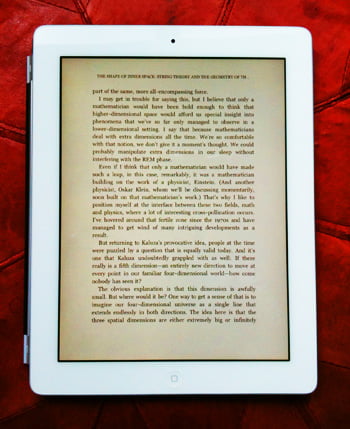
my iPad...

Let me whisper to you a heresy: ebooks may be aesthetically superior to paper books. There, I’ve said it. Before they come for me, to burn me as a witch, let me try to explain what I mean.

First I would like to distinguish two different functional components of the paper book: the paper book as machine and the paper book as a (complex) surface that bears text. Though it is the latter that concerns me most here, I will say the following about the former:

Ebook reading devices can not only emulate many of the page turning, indexing, book marking etc functions of the paper book, but, by being programmable, can provide us with new facilities: ebooks can be searched, linked to other texts (or images, sounds, video etc), typographically modified (to use different fonts, or to use different sized fonts – thus tailoring the reading experience to the reader), and can come to possess any number of other features thought of or unthought of to date. These ergonomic issues are, of course, aesthetic in their own right, as are the actual physical characteristics of the paper book. This latter point seems to come up time and time again especially in the context of the ‘feel and smell’ of inked paper. I am the last person to dismiss this preference. However, not only is it possible that ebook devices will come to emulate – if the desire for this should continue – the ‘feel’ and ‘look’ of paper, but I would suggest that the ebook can bring its own feel and look to the reading experience; the slickness of metal and glass and all manner of textured plastics, and who knows what other materials. These particular aesthetic aspects of physicality will, no doubt, long continue to be a bone of contention – at least for those of us who have grown up with paper books.

Setting aside these considerations, I would like to turn to the second of my functional components: the book as a surface that bears text. This surface in paper books (and in scrolls, tablets and other devices that preceded the codex) is, after all, the one that most matters; it is that through which we actually ‘read’ the book. I would suggest that it is this surface that constitutes the primary aesthetic of any book (second only to its content). In the West (and I believe this carries through to other orthographies, printed or otherwise) the locus of this aesthetic lies in the laying out on the surface of crisp black characters in lines and in paragraph blocks, culminating in a macro-block, consisting of these components, that forms a ‘page’. It is thus the page that is central (everything else is merely a means of moving from one page to another). And it seems to me that there are two aesthetics that dominate the page: the quality of the print and the orthogonality of all the elements on a page.

Print by its very nature privileges repetition over individual uniqueness. For centuries scribes struggled manually to make each example of a given character identical to every other. With the advent of printing this became just about possible. I believe that the ebook represents the culmination of this process… for even printed books suffer from variations in ink density across a page and, because paper is an organic substrate, the kerning between printed characters can vary. Ebooks, by contrast, supply us with text that is of a perfectly uniform density and with precise, invariable kerning.

Similarly, the orthogonality of the macro-block of text on an ebook page is also invariable, whereas its paper counterpart is not. However, there is, I feel, a more important difference in the orthogonality (the perils of orthogonality are another matter: refer to “orthogonality” tag) of the macro-block: the gutter of a paper book. We are so accustomed to this that we hardly notice it, however, it is for many of us a cause of some irritation. It seems to me that, with all the advantages gained in the move from scroll to codex, there came also a major disadvantage: the gutter that was introduced by the need to attach the pages to the spine. Of course, in expensive books, hardcover rather than paperback (or even worse, those that are perfect bound), the way a page slopes down into a gutter is somewhat ameliorated – not only because the superior binding allows the book to lie flatter when open, but also because the macro-block is often kept away from the gutter by a wider margin. Paperbacks are altogether a different matter, with sometimes a reader being forced to peer down into the gutter into which the text seems to be slipping. In this sort of book the reader almost has to pull it apart to read it; perfect bound books literally come apart, so that the cover ends up as a folder holding a sheaf of loose pages.

The reader of an ebook is spared all of these misfortunes. Each page is presented perfectly flat and square and with no danger of being lost or of any damage coming to the device from the attempt to read what it displays.

So – I’ve not got long now before they come for me – though ebooks may be extremely disruptive to us readers, and though some things may be lost, I feel that, on balance, ebooks are destined to provide us with an aesthetically (never mind functionally) superior reading experience…

Tags: , , , , ,
10 Comments »